ved mehta - een introductie
Contemporary Authors Essay
(Amplified and Revised After Publication, 9/17/03)
In 1954, when I was twenty and studying at Pomona College in Southern California, I took a train to Seattle, Washington, the hometown of my fellow student JoAn Johnstone, and got myself a one-room, efficiency apartment, and started dictating to her my life story for eight hours a day, six days a week, oblivious of the city life going on outside. That summer it seemed to rain every day, and situated as Seattle was on the Puget Sound, the fog seemed to roll in at any and all times of the day. Anyway, I felt I wasn’t missing much staying snug inside and working. At the time, I had been speaking English for only five years. I had not read deeply and didn’t know much about writing. But the wish to explain my life to JoAn and to arouse her interest and sympathy was urgent.
Five years earlier, I had flown alone to America from India, the country of my birth, and entered the Arkansas School for the Blind to obtain the education that was unavailable to me — indeed to all the blind people — at home. I had lost my sight just short of my fourth birthday as a result of meningitis, and had grown up in India mostly without formal education. At the Arkansas School, I had compressed my elementary and high-school education into three years, and there, as later at Pomona, felt cut off from everyone I knew and loved back in India, somewhat like a sailor sent out to sea.
At Pomona, I thought that the ache of my loneliness might be assuaged if I could get JoAn, the campus belle, to go out with me. Like other sought-after girls, she was pretty, fresh-faced, and outgoing, but she was also highly intelligent and serious — qualities she always hid because, in the fifties, young men considered smart girls threatening. And she had such a kind, bright voice that just to hear her greet me on a campus path thrilled me. But although we were both sophomores and had many classes together, there was as much chance of my dating her as of my being in the driver’s seat of a car and cruising down a freeway. I was the only Hindu there, and I was shy, studious, and unathletic, while the college ethos was essentially Christian, white, and outdoor Southern Californian (the beach, pep rallies, and football). Above all, it seemed that at Pomona the only way a man could get a date was to have a car — ideally, a gleaming convertible with tail fins.
The closest movie theatre was too far to walk to, and drive-in movies and good restaurants were even further away, in Los Angeles. Those of us who didn’t have a car could make do with the few dour bluestockings who were willing to go to the Sugarbowl, a dumpy little café within walking distance of the college. Run by a couple of prim spinsters, it was usually half-empty and didn’t have so much as a jukebox to liven it up. Even on a Saturday night, the clientele of the Sugarbowl was like its name: plain and homey, lacking the dash and glamour of the car crowd. But try as I might, I couldn’t get JoAn out of my head.
JoAn and I often had to read the same assigned texts; I arranged for her to become one of my paid readers. Then, one day, she told me that she needed a summer job to defray her college expenses, and I hit upon the plan of hiring her as my amanuensis for the coming summer and dictating to her my personal history. The dreamer in me imagined that if she came to know it she might fall in love with me — stranger things were known to happen. I fancied that even if I never ended up dating her, if she accepted my offer, then at least for a whole summer her voice would be in my ear and the breath of her presence would surround me and so, perhaps, soften the edge of my loneliness. The idea of my travelling all the way to Seattle to work with JoAn seemed bizarre to her, but eventually she accepted my offer.
Once I started dictating, the material arranged itself into episodes and scenes, conversations and reflections, if in a bareboned way. JoAn wrote down everything in longhand with a fountain pen, forming my words with brisk strokes and scratches and little taps as she finished one line and started another. Sometimes when I was dictating to her, I daydreamed that I was in fact in the driver’s seat of a car and that she was sitting in the passenger seat, that we were travelling far, far away from Seattle and Pomona, on our way to India: to Bombay, Rawalpindi, and Simla, the cities where I had grown up; to my hometown, Lahore, from which my family and I had had to flee for our lives to escape riots and savageries over the Partition of India; and to New Delhi, where we were swept up in the wave of refugees after the creation of Pakistan in 1947. I imagined that she came along with me everywhere as I revisited scenes of my childhood — family weddings, Hindu festivals, and strolls in the Lawrence Gardens in Lahore. I even fancied I was preparing her to settle down with me among my relatives in India.
I dictated to her the story of how, before I was five, my doctor father had sent me to Dadar School for the Blind in Bombay, some thirteen hundred miles from home, in the mistaken belief that it was a British-type boarding school; how the school had turned out to be an orphanage-cum-asylum; how I had been the only boy there with shoes; how, through a special arrangement, I had slept on a mattress instead of the standard wooden planks and taken my meals with the principal and his wife; how I had been excused from caning chairs, a skill all the other inmates were learning as a means of earning a livelihood; how I had been sick there almost half the time; and how I had been returned home after three years because there was nothing more the school could teach me. JoAn heard how my father, an apostle of learning who was trying to give all his children the best education available in India, had tried to make arrangements to send me to school in America, but it was during the middle of the Second World War, when there was no way to get me overseas. I told of trying to occupy myself at home as best I could by flying kites, playing with Meccano sets, doing a little carpentering, and teaching myself, among other things, to ride a bicycle. I might sit around with the servants, or amuse myself alone in the compound, disassembling a bicycle, a fan, or a tap and then reassembling it to see how it worked. Still, as often as not, the day would stretch ahead of me without anything to do. No matter what I was doing — or not doing — I fretted that I was missing out on an education and would end up a beggar, as many of the denizens of the orphanage did.
Now I worried that there was a certain reticence in the account I was dictating to JoAn, but I was hard-pressed to put my finger on the reason for it. Could it be traced to my stay at the orphanage, indeed, my leaving for America at the age of fifteen? Or could it be that in remaking myself quickly into an American, I had suppressed my Indianness? Or had it something to do with the condition of my writing — my unrequited love for her? Throughout, I tried to present my best face to her. Shyness inevitably permeated the story I was dictating, just as it did my relationship with her.
Although every day she prepared for us a simple lunch, which we ate sitting at the desk, I hardly so much as touched the hand of my recording angel. If my loneliness was somewhat assuaged when she was with me, when she left, sadness would grip me like a fever. I would fantasize about spending the evening with her — holding her, taking her out to dinner or to a movie or a play, like a normal man. But I couldn’t forget that I was an inadequate suitor, not just for JoAn but for any sighted girl. That was my overdeveloped rational and realistic side, which pushed down my own healthy wishes. Indeed, I feared that if I crossed the boundary of our professional relationship, she would abandon me and the manuscript. Even though the manuscript grew day by day, that did nothing to mitigate my loneliness. On the contrary, writing made me feel more different—more alien, more deprived—and emphasized my growing realization that the America I was living in had no points of contact with the India I was writing about. Even though on one level I was dictating a love letter to JoAn, the manuscript had an impersonal, detached tone, making me wonder whether my narrative would have been different, less restrained, more freewheeling if I had been able to write the book on my own, like other writers. I certainly was not able to speak my inner thoughts and inner longings aloud to JoAn.
Irrespective of my private thoughts and secret wishes, I resolutely kept to the professional basis of our relationship. Day by day I continued with my story: My father never wavered in his high ambition for me. At one point, no doubt thinking that I might not be able to get any normal schooling, he engaged a series of classical singing masters. He had known of a blind singing master who did so well for himself that, instead of going around on a bicycle, like my sighted singing masters, he kept his own private tonga and tonga-wallah and drove to the houses of his clients reclining on the seat like a nawab. My father thought that music might one day provide me with not only solace but also an enviable livelihood. I had a good singing voice, and when I sang popular film songs, which my masters disapproved of but which were a staple of family gatherings, I brought tears to everyone’s eyes. I think the family found my singing in a child’s voice touching; but once my voice changed, I lost whatever modicum of interest I had had in singing classical or popular music. In any event, the thrust of my own ambition was to be like my four older siblings. That meant going to school like them — reading, writing, talking, thinking, even dreaming in English. As it was, I could read and write only some Braille, and spoke only Hindi and Punjabi.
When I was about thirteen, I got a chance to go to a school, in a manner of speaking. I was admitted to St. Dunstan’s, an institution for the Indian war-blinded in Dehra Dun, because of my father’s high government position, though I was underage and a civilian. Most of the soldiers there were more than twice my age and illiterate. Having gone blind recently, they had practically no facial vision — a sort of sixth sense that blind children develop to perceive objects and terrain by means of what I call sound-shadows. There was so much infernal banging and crashing all day long as the blind soldiers went around from hostel to latrine to workshop to classroom to kitchen — running their walking sticks along the metal wires that had been installed on steel posts throughout the compound to guide them — that my own facial vision was impaired, causing me to smash into the posts. But the more my eyebrows and forehead swelled up with lumps, the more determinedly I ran around the compound unaided by sticks or guide wires, as if to set myself apart from the rest of the inmates.
My only regular class was with the few soldiers who had some elementary education. We were taught touch-typing, together with elementary English. One of my fellow-classmates was a man who had lost his arms as well as his sight and typed with a metal prosthesis attached to a stump. His persistent scrapes and rasps on a specially designed keyboard with holes for keys goaded me to work at my typing exercises, and eventually I achieved a speed of eighty words a minute.
When I had been at St. Dunstan’s for barely six months, the authorities wrote to my father, saying that the company of embittered, older, lonely men who were separated from their wives and children was unhealthy for me, and that I should be returned home. Indeed, at any opportunity the men would grab and paw me — it was all I could do to get away from them. My father promptly withdrew me from the institution.
Back at home, I again sank into a depression, but for the first time I had at my command a means of communicating with the outside world. I started typing out letters to schools and organizations for the blind everywhere, telling them about my inability to receive an education in India and pleading with them to give me an opportunity to train and develop my mind, all the while imagining that my typewriter was a ship carrying me to England and America. I received a stream of rejections, from every place I applied to, on the ground that no one could see how a boy could start his education at such a late age, and that even if I were to get some schooling it would make me culturally maladjusted, fit to live in neither the East nor the West. They encouraged me to obtain whatever schooling I could at home and to concentrate on my music. Finally, I received a letter of acceptance, from the Arkansas School for the Blind.
The only thing my father knew about Arkansas was how the name of the state was pronounced. Anyway, he had no idea whether the school was an elementary or a high school, whether it was for black children or white children, whether it was a school building or a camp, like St. Dunstan’s. Moreover, financially ruined by the Partition, he could scarcely get together the money for a year of my room and board there. But I was determined to go and I had my letter of acceptance in hand, sine qua non for getting a student visa. And so, with warnings of impending disaster from all our relatives, but with blessings from my father, I flew to America.
As it happened, I completed the Indian part of my narrative at the end of the summer, when JoAn and I had to return to college. I felt it was just as well to stop there. It had been relatively easy to get a perspective on my distant Indian past; the personalities who figured in the narrative were frozen in time, and stood still in front of my desk for my study. In contrast, my American school experiences were ongoing, so I said goodbye to JoAn, telling myself that I had spared both her and me my fumbling attempts to record something meaningful about America.
But my relief was momentary. I was finally forced to acknowledge that my story, instead of making her fall in love with me, had had the ironic effect of estranging her from me: she felt I had achieved something that summer, was well along with a book, the kind we studied in college, while she, she said, had done nothing. That was not, of course, entirely true. Without her help, the manuscript would not have existed. But that is how she perceived things and with such conviction that in our remaining two years of college she stopped even reading to me. We drifted apart.
I was so respectful of JoAn that I did not break my silence about my unrequited love for her until the publication of my eighteenth book, “The Stolen Light” (1989), in which I wrote of that summer. By that time, we were both married, had children, and were living on opposite coasts. I sent her a copy of the book but never heard from her. It was a testament to the intensity of my feelings for her, though, that when I had come to write about her I felt that she was sitting across the desk from me in Seattle, as she had done some thirty-five years earlier.
After Seattle I went back to my college studies and didn’t look at the manuscript for two years. Then, on my way to Oxford for further studies, upon graduation from Pomona, I spent a couple of months in Cambridge, Massachusetts, completing the book with another amanuensis, a Radcliffe English major by the name of Grace. The book was edited by Edward A. Weeks, editor-in-chief of The Atlantic Monthly, and published as “Face to Face” in 1957, when I was twenty-three.
My writing life began because of my love for JoAn. In due course, I fell in love with the process of writing itself, publishing over the next forty-seven years twenty-five books, each dictated to an amanuensis who was my first reader and a witness to my daily struggles with words. (I continued to type letters, but since I couldn’t read what I had typed, typing proved useless for writing and rewriting. Also, an amanuensis was essential for looking up things and doing further research.) When my writing was going well, I felt a little like Scheherazade, entertaining my amanuensis, bedeviled by the dread that if I ran out of things to write, I would lose face with my scribe along with my means to live; except for a series of grants, fellowships, and awards, I have earned my living by writing since I was twenty-five. Anyway, the process of writing, private for most writers, for me has always had a public dimension and, with the passing of each year, becomes more, rather than less, mortifying. Even today I have great inhibitions about dictating intimate, uncensored, raw material. The process, however, is not without its advantages: Although I am meticulous about grammar and punctuation and constantly review what I write with my inner eye, I am guided every inch of the way by the sound of words, their rhythm and cadence. Thus readers interested in getting the full flavor of my writing might wish to read it aloud.
My particular method of writing, combined with the pressure of writing itself, was so time-consuming that it invaded all my waking hours. One deleterious consequence was that, despite my conscious desire to have a family and settle down, my personal life remained stalled and unfulfilled for a long time
In 1956, I started working for a second bachelor’s degree, at Oxford. In those days that was the best way to enter into the stream of Oxford and English life. I was required to write an essay or two a week and meet with my tutor with a partner. It was exhilarating to subject one’s writing to a world authority on a subject. While my partner was reading one of my first essays to R. W. Southern, my medieval-history tutor, he intervened just after my partner had read the word “motivation” in my essay and asked how it was that I tended to reach for jargon when a good English word was to hand. “Jargon is imprecise and encourages weak thought,” he said. “A careful writer would use a word like ‘impulse.’” I was so deeply in awe of Southern, Oxford, and its tutorial system, and so impressionable, that the questioning of one infelicitous word had the effect of unraveling my self-confidence in my writing even as it began to sensitize me to the nuances of words. In time, I came to write what I called a “vomit draft” of my essays, in which I would let myself go and write freely, without a thought for grammar or diction. Then I would start laboriously revising, editing, and rewriting, even so arriving at my tutor’s door with a messy piece of work.
I discovered that many of my clever contemporaries who wrote well had learned to write at school, before coming up to Oxford, by imitating the styles of great authors or, if they were studying Classics, by translating Latin or Greek prose or verse into the style of contemporary English authors or poets, and vice versa. Sometimes these undergraduates wrote with a certain archness and artificiality, but the best of them wrote with a grace and elegance that was as intimidating as it was astonishing. It was clear to me that, compared to them, I was poorly prepared. The more inferior to them I felt, the harder I labored to improve my prose.
Quite early on, Southern suggested that I dip into “The Oxford Book of English Prose,” an anthology culled by Sir Arthur Quiller-Couch and published in 1925. It was a collection of choice morsels by authors such as Chaucer, Shakespeare, Milton, Swift, Samuel Johnson, Lamb, Coleridge, Jane Austen, De Quincey, the Brontë sisters, Melville, Dickens, Matthew Arnold, and Shaw. Whenever I had some extra time with a reader, I would read and reread a selection to ponder its tone and cadence, its diction and imagery, its movement and structure. In time and with practice, I began to develop my own voice and style.
At Oxford there was a pretense that clever undergraduates did brilliantly without working. In fact, many of them spent the day sitting around in the common room reading newspapers and matching wits with their peers, or drinking, gambling, or attending one of the countless undergraduate debating, intellectual, theatrical, or social clubs. They seemed to do their work secretly, at night. In contrast, I had to adapt my work habits to when I could get readers, which was generally before ten o’clock in the evening. And reading aloud was many times slower than reading to oneself; sometimes I had to consult as many as a dozen books and as many articles for one weekly essay. Whenever I worried about being branded a “troglodyte” because I could not work in secret, I would think of Southern. The light in his office seemed always to be on, as if he never slept.
In 1959, after finishing my degree at Oxford, I returned to India and set about reacquainting myself with my family and country. My little brother, who had been a compliant child of five when I left home, was now a rebellious boy of fifteen. Although I scorned “Face to Face” as a piece of juvenilia, by someone who would probably always be a one-book writer, it had received considerable acclaim when it was published in Britain, a year earlier. Indeed, the book was well-known in the small community of politicians, civil servants, professors, and journalists who seemed to form a sort of village within New Delhi. As a result, one day I was having lunch with Prime Minister Jawaharlal Nehru; another day I was addressing students at Delhi University; still another day, I was giving an interview to the leading English-language newspaper and being invited to write for it. In the middle of all this, I met up with my Indian poet friend from Oxford, Dom Moraes, who happened to be living in a Delhi hotel suite with his father, Frank Moraes, a distinguished Indian journalist. Frank, himself an Oxford man, lived like an Englishman, giving rounds of lunches, dinners, and cocktail parties. I was soon dividing my time between my family in their small refugee house and Dom in his father’s hotel suite. At one point, Dom and I escaped Delhi and cut a swath through Nepal and India. He was much more famous than I was — while at Oxford, he had won the prestigious Hawthornden Prize when he was barely twenty — and I traveled with him a little like Jeeves with Bertie Wooster, or Sancho Panza with Don Quixote. But that summer, in Delhi or on the road, wherever I went and whatever I did, I felt out of place. I had become a stranger to my own family and country.
In the meantime, I had been awarded a prize fellowship to do a Ph.D. in history at Harvard and a position as a residential fellow at Eliot House there. Without the prospect of any regular employment in India and without any private means, I went to Harvard, thinking that my karma was to become an academic.
Although I settled down to my studies, I felt an insistent need to write something about my summer experiences. I canvassed editors of publications in London and New York to see if I could stir up interest in an article or two, but in vain. Then one day, through an introduction from a journalist friend, I found myself in the office of William Shawn, the editor-in-chief of The New Yorker. He had the luminous intelligence of an Oxford don but the saintly manners of a mahatma.
Excited by my meeting with Shawn, I went back to Harvard and in three weeks wrote a high-spirited account of my sojourn in India and Nepal. “Indian Summer,” as I called it, became my first piece in The New Yorker, on January 2, 1960. A few months later, the magazine published “Homecoming,” a bittersweet second piece, about my coming to terms with my family, Indian bureaucrats, and Indian politicians — with India in general.
“Indian Summer” had made no mention of my blindness, in part because it had no role in the piece; and The New Yorker did not provide any biographical information about its contributors. In any case, it was published in the slot the magazine reserved for fiction, and for the “editors” — code word for “Shawn” — to have noted that I was blind would have been no more relevant than if the story had been by, say, Borges or, for that matter, the elderly Joyce. “Homecoming,” however, was a factual account published under the rubric “Reporter at Large.” In that piece I described what people did and said, together with their looks, their gestures, their mannerisms, and their surroundings. As I wrote it, I had no idea about journalistic techniques and conventions. As in the case of “Indian Summer,” I just sat down in my room in Eliot House and dictated it. Description of people and places came easily to me. After all, I lived and functioned in a visual world and absorbed the world around me through other people’s eyes and their chance observations. I certainly had no idea that I was doing something novel or different. Everything in the piece was checked by the magazine’s checkers and my reporting was found to be accurate — “the proof was in the pudding,” as they say. Anyway, Shawn didn’t raise the question of my blindness, no doubt in deference to my sensibility. Moreover, The New Yorker had a tradition of not writing about what research went into a story or how its material had been gathered, in contrast to some other magazines, whose writers and editors made such mechanics part of their stories, as if to congratulate themselves on their hard work. (That tradition, like so many others, was jettisoned by the magazine’s new owner and his appointees.)
I myself gave no thought to my blindness; I dismissed it as a distraction — it was not pertinent to how I lived. Indeed, I moved around the New York streets like an ordinary person, as if I could see. I traveled around with my eyes open, without a cane or a seeing-eye dog, and without the conventional mannerisms associated with blindness, such as not looking at the person one was talking to, generally keeping one’s head down, mouth open, and eyes shut, as if one were asleep. I was fiercely independent and insisted on being treated like anyone else.
Yet some of my relatives and friends seemed to be disturbed by my new style of writing in The New Yorker — they would have preferred to have me write like the blind narrator of “Face to Face,” who had avoided striking visual imagery. That was more familiar to them, less confusing. I recently came upon a letter the poet Robert (Cal) Lowell, a new friend at Harvard, wrote on January 4, 1960, to Elizabeth Bishop, whose poem “Brazil, January 1, 1502” had appeared in the issue of The New Yorker in which I had made my debut. “By the way, have you read the story by the Hindu, Ved Mehta, that envelops and surrounds your poem?,” he wrote. “He’s [a] new friend of ours. Since three he has been blind, and puzzles people by loading his conversation and writings with visual images. His face and eyes quiver at you when he is talking or listening, and few people with sight are half as sensitive and knowing.”
Although I couldn’t have verbalized it then, the truth was that I thought in —
lived in — “visual images,” perhaps because I had been able to see as a small child. Of course, I had had no subsequent visual reinforcement; still, I was surrounded by people who constantly talked visually.
With additional material, the two pieces were published as my second book, “Walking the Indian Streets” (1960). The first edition of the book made no mention of my blindness, and all the reviews accepted it on my terms, except for one strange review in The New York Times Book Review. Ordinarily, I would have sloughed off such a review, but because my new way of writing was now at stake, I decided to answer it, saying that Beethoven had been deaf when he had written the Ninth Symphony and no one thought of that when they listened to it. As a further defense, I got the publisher of the English edition of the book to insert a note explaining that I described people and places by relying on my keen ear and piecing together, like a historian, clues and evidence that I happened upon. It went on to state that I didn’t want any concession made for me on account of my blindness, and that no such note would appear in my future books — and none did. Until I started writing about the subject myself, I did not allow publishers to use my picture, either on a dust-cover or in publicity material. For years, I even avoided appearing on television, so much so that my face was disassociated from my writing.
When I applied to Harvard, I had expressed my preference for doing a Ph.D. in English literature rather than in history, because my interests were becoming increasingly literary. Even while at Oxford, I had taken time out from history to formally study Milton and then slipped back to America and enrolled at Harvard Summer School to take courses in Chaucer and twentieth-century novelists. But the fellowship awarded to me was in history, no doubt because the Harvard authorities thought that I was a known quantity in that subject but not in literature. Once at Harvard, I got myself excused from most of the routine history courses and lectures since they repeated the work I’d already done at Oxford and designed my own interdisciplinary thesis topic, the portrayal of Indians in nineteenth-century novels, so that I could do less history and more literature. But there was no getting around taking certain history seminars and mandatory examinations and fulfilling the resident requirement before Harvard would give me a green light to write my thesis. That was especially galling, because had I stayed on at Oxford I would have been allowed to write my thesis without any further academic obligations.
But Harvard understandably took the view that I had to prove myself again to my new university. I felt restive. I had already been at colleges and universities for seven years without interruption even for summers, when I went to summer schools. Then, to my surprise, the Harvard authorities did not take kindly to my moonlighting for The New Yorker. They maintained that my writing was a diversion from my studies. I told them that I had always thought of myself as primarily an academic, that unlike aspiring student journalists I had scarcely written for undergraduate publications either at Pomona or at Oxford — indeed, looked down my nose at them. But one of my Harvard professors, W. K. Jordan, bluntly told me that I had to choose between being a serious academic or a popular writer. Jordan, though a respected seventeenth-century historian, was himself a plodding writer. I argued with him that some of the best Oxford dons, like J. R. R. Tolkien and A. J. P. Taylor, combined writing with scholarship, as had dons of earlier generations, like C. S. Lewis and Charles Lutwidge Dodgson (Lewis Carroll). I mentioned that some of Harvard’s own professors, like Arthur M. Schlesinger, Jr., wrote for popular magazines. One Harvard professor, H. Stuart Hughes, was even then campaigning for a seat in the United States Senate. But Jordan was unyielding, and so was the history department: a financially assisted graduate student, it seemed, could not lay claim to the privileges of dons and professors.
Sometimes I felt so alienated from my Harvard milieu and the history department that I thought of renouncing my fellowship, along with my paymaster, and supporting myself as a graduate student in England on the savings from my two books and New Yorker payments, especially after Jordan and Crane Brinton, another of my professors, told me that they didn’t think that a blind person could be a first-rate scholar. I was jolted because I had not encountered such prejudice at Oxford, where dons and my fellow- undergraduates had treated me as an intellectual equal, perhaps because they had had firsthand experience of blind scholars. In my time, two top law tutors at two top colleges were blind. And there were historical examples never far from the university’s consciousness, like that of Milton, who had lost his sight in 1652 at the age of forty-four and not only continued to serve as Latin Secretary to the newly formed Council of State until the Restoration but also wrote “Paradise Lost” and “Paradise Regained.” If I had discerned any soft spot in the wall of prejudice of my Harvard history professors I might have turned myself into a battering ram. But, as it was, I was at Harvard before the civil-rights movement of the sixties had gathered momentum, and the campaign for equal rights for the disabled was not yet even distant thunder. Anyway, by temperament I was not aggressive, so I mostly sulked, secretly deriding my Harvard professors for, while perhaps being demon researchers, lacking the stylistic distinction to which I aspired.
Meanwhile, I took the precaution of getting myself admitted to St. John’s College, Cambridge. At the same time, I reached out to the larger Harvard community of faculty members who were less parochial, and who liked my New Yorker pieces and didn’t think of me as just another graduate student: sociologist David Riesman, classicist Arthur Darby Nock, and China specialist John Fairbank. Much like the dons at Oxford, they didn’t stand on ceremony as the Harvard history professors did, and they came to my rooms at Eliot House for parties. Fairbank, who had gone not only to Oxford but also to Balliol, my college, had me regularly to teas that he and his wife, Wilma, held for his students at their home and also to Sunday night suppers at Peking on Mystic in Medford, where we went dutch, reinforcing my feeling that, for all that we were professor and student, we were in some ways equal. I was also befriended by the critic Edmund Wilson, who was teaching at Harvard at the time but did not fit comfortably into the English Department. Cal Lowell and his wife Elizabeth Hardwick had me to their house for dinners, and Cal also included me in a group of his men friends who would every so often book a room at Locke-Ober for dinner and talk. But listening to the men swapping gossip about Harvard made me feel I was outside looking in — a feeling I had always had, no matter where I was.
In 1961, in the middle of my second year at Harvard, I rashly decided to jump ship — the first time in my life I ever left anything unfinished — and move to New York, to try my luck as a writer. In later years, I would wonder how it was that I had dared to make myself a permanent exile from the protected world of university and scholarship, throwing away in one inexplicable moment a life perfectly suited to my academic training, my temperament, my disability, my interests, and my financial exigencies, and, without any family at my back (I was as alone in America as when I had first come to the country, in 1949), to commit myself to the perilous world of writing and journalism, which was said to be as dangerous as a snake pit. I never could work out how it was that without stopping to think I had cast my lot with the quixotic tribe of writers who lived from piece to piece, book to book. (All the writers I had known in England either had private means or spouses who supported them; not one of them was able to pay his rent with earnings from his pen.) On top of everything, English was my fourth language, and I could not function without an amanuensis. I was determined to make my way as an ordinary writer would, English or American, and to compete on equal terms with writers who could see. I certainly was not the kind of person who would ever ask for quarter no matter how ill-equipped I was for the fight.
I went to pay a last visit on the Lowells, who were themselves moving to New York. Indeed, Liz had recently published in Harpers a diatribe saying Boston was dead. Cal said that I wouldn’t last a year in New York — that outside a university setting I would probably kill myself. I remember thinking rather truculently that if that were in the cards there was nothing I could do about it — that there was even something romantic about dying young. I now realize how depressing Harvard must have been for me after Oxford, that I must have had little idea what I was doing when I gave Harvard the chuck.
In my early days in New York, I missed the ease of campus life, where there were traffic-free quadrangles and a yard where I could walk to any building without losing a step; where I could scarcely go outside my room without meeting a friend; where breakfast, lunch, and dinner were laid on weekdays and weekends, and I didn’t even have to toast a slice of bread. Most vexing was the problem of eating: I now had to walk alone into a restaurant and sit at a table for two, the empty chair underscoring my isolation in my new life. Sooner or later, the maître d’ or a waiter was sure to come and bellow, “All alone today?,” making public my private discomfort. I soon began frequenting a wonderful bistro near my apartment building on East 58th Street named L’Escargot, where the waiters got to know me and didn’t mind a single occupant at the table and so a smaller tip. Before I knew it, I had got addicted to the restaurant’s appetizer, oeufs à la russe, or eggs with caviar, and I could afford to eat there only a few days a month. A colleague suggested getting a dinner in a plastic sack, which had only to be boiled, cut open with scissors, and dumped on a plate. As I stood by the stove, waiting for the pot with my dinner of boeuf Bourgignon to boil, the sack exploded and my dinner started raining on my head from the ceiling. Not knowing how to clean up the mess, I ran out of the kitchen and closed the door behind me, only to be visited by dreams of cockroaches crawling on my pillow.
I might not have survived the jungle and chaos of New York, the demands of my new, overwhelming responsibilities, and the constant lows of a writing life if it hadn’t been for my relationship with William Shawn. From the first day, he was as welcoming and present as Harvard graduate school had been frigid and remote. We had talked for some time about my moving to New York, and, when I turned up at the magazine, he showed me to an office, the nearest fire escape, and the bathroom, in that order.
As he was leaving, I mentioned to him that I couldn’t work without an amanuensis. Until then, he had had no idea how I wrote, how I read the proofs, how I went over his editorial suggestions. But he immediately took the necessary steps to provide me the following week with a full-time amanuensis, without so much as hinting that New Yorker writers were basically freelancers and so hiring my amanuensis should be my concern, or that we should hold off on the problem until I had proved that I could continue to write pieces that The New Yorker would want. He left me alone with a typewriter to work out my destiny as a writer.
I was scared. For days, I was paralyzed by the terror of the blank page. I lacked the necessary writing skills — I could play only five-finger exercises, as it were. In any event, under Shawn’s benevolent aegis, I practiced stretching and flexing until, gradually, I was able to extend my writing muscles. In time, I was able to range all over the keyboard. With growing dexterity and confidence came the wish to take greater risks and undertake bigger projects and more difficult subjects.
I was a staff writer on The New Yorker for thirty-three years. For twenty-six of those years, Shawn was the editor. Although at his New Yorker there was no tenure, no seniority, no guarantee of publication, or even of an office year to year, his vote of unconditional confidence kept me going. He unreservedly supported me in my growing feeling that there was nothing I couldn’t do — that physical limitation was no impediment to creative and imaginative work. Most of the time, therefore, I was up in the air, trying to do one high-wire act after another.
No fewer than eighteen of my books originated as articles and stories in The New Yorker. Much of my time and intellectual energy was spent experimenting with different forms to accommodate what I wanted to write about. In my early days, Shawn suggested the subject of Oxford philosophy, and I leapt at the idea without stopping to think how I could take an abstruse academic subject and turn it into a story, how I could explain the passions of Oxford philosophers, together with their quirks and foibles, in a way that would exalt them — they were all leaders in their field. I got in touch with several old Oxford friends and ended up making them into a composite guide, who explained the subject even as he exemplified it. With him in place, it was not difficult to dramatize the differences and convergences of the philosophers and thread their conflicting theories and opinions together to give them coherence and to give the piece a form. One form, however, could not be carried over to another piece or another book — so each subject, each story required me to come up with a suitable form.
In my first New York decade, 1961-71, I published five additional books, goaded as much as anything by my need to earn my living through writing. “Fly and the Fly-Bottle” (1963), my third book, was about those Oxford philosophers and contemporary historians who were overturning old assumptions about what philosophy was and how history should be written. “The New Theologian” (1966), my fourth, was about contemporary Christian theologians who in their eagerness to reconcile faith with science were repudiating miracles like the Virgin Birth as hangovers from a superstitious age, some of them going as far as to say that God was “dead.” “Delinquent Chacha” (1967), my fifth book, was a comic novel set in India and England about a rascally but enchanting middle-aged Indian who had spent his early years under the British Raj and, finding himself deep in nostalgia now that India was independent, wanted nothing so much as to turn himself into an English gentleman. “Portrait of India” (1970), my sixth, was an attempt to encompass in a single big volume the country’s geography, history, religions, people, politics, economy, and art. In “John is Easy to Please” (1971), my seventh, I collected my occasional New Yorker pieces on language and linguistics.
As a reporter — and reporting forms the scaffolding of many of my pieces and books — I labored under many disadvantages. I constantly had to appear in rooms and places where I had never been, and I never told the people I would be meeting that I couldn’t see. I felt that would put them off, perhaps even cause them to deny me an opportunity to talk to them. Wherever I went, I was all ears for visual clues that would later help me to reconstruct the scene on paper. Also, I had no means of jotting down what people said; Braille was too slow and cumbersome for note-taking — for the same reason, I had not been able to take notes at college and university lectures and so had to rely on my memory. The few times I used a tape recorder at formal interviews, it proved deadly, because it interposed a mechanical presence between my interlocutor and me, making him or her self-conscious and less natural. In any case, I gathered some of my best material when I followed the person around, observing him doing things that he generally did in the normal course of his day. In fact, interviews and conversations flowed best when I was a sort of invisible presence, the proverbial fly on the wall.
I was as empty-handed when I was travelling as I was when I was interviewing. I always had to make a special effort to put people I might write about at their ease. I imagined that what I lacked in the tools of my trade I made up for with my keen ear and unflagging attention. I sometimes even thought that my inadequacy was not without its positive aspect. At least at the first encounter, it gave my interviews a certain edge — I was as vulnerable as the person I was talking to, and he revealed himself to me. For my part, I listened to the undercurrent of the conversation, alert for the chance remark or interesting observation, a spontaneous action or a critical moment, something that would provide me a window into the soul of the person. Unlike my colleagues, who came home with reams of notes or undigested transcripts of tape recordings, I was able to do the editing work, so to speak, on the spot. But my method was not without its risks. Sometimes the conversations went on for hours over drinks, lunch, and tea, making what was said or what happened fuzzy as the time went on. I trained myself to underline in my mind what I would later want to remember. The whole experience of collecting material in this way would leave me limp, my four senses so strained and stretched from trying to take everything in that I could scarcely stay awake in a taxi taking me back to my hotel or wherever. If I so much as dozed before typing or dictating my firsthand impressions and memories, though, they would evaporate. It seemed everything I wanted to remember had to be held in my mind whole or it would slip away like a morning dream.
But in this “media age,” when wars can be televised and sometimes even a murder captured on film, firsthand impressions — the stock in trade of a reporter — are not prized highly. Still, I, for one, go on believing in their primacy. Indeed, my firsthand impressions have been the source of much of my writing. I remember only one instance when I relied lazily on a friend’s impression. That was when I came to write, in “The Stolen Light,” about E. Wilson Lyon, president of Pomona College, whom I hadn’t encountered for twenty years or so. Following its publication, I happened to run into him and realized that I had, by my secondhand account, ended up misrepresenting him. I was so mortified that to this day I continue to be haunted by my error.
I have such faith in the sanctity of firsthand impressions that I have never taken a friend or an amanuensis on a reporting assignment with one signal exception, and that was in 1966, when I was in India collecting material for what became “Portrait of India.” For months I had been crisscrossing the country, getting up at five or six in the morning and travelling until eleven or twelve at night. I was utterly exhausted and, on an impulse, asked Lola, a young woman who was doing part-time secretarial work for me, if she would like to come travelling with me. She immediately agreed, and after that, for five weeks, we went around the country together. She took down my conversations in shorthand and even recorded her own impressions of the people we met. Whenever we compared notes, I was surprised by how eerily similar our impressions were. Indeed, our personalities and ideas meshed, so much so that it was rather like discovering a double, and that of the opposite sex. She was the amanuensis of my dreams, but a dream realized. We became lovers. I thought if I could have seen, I would have seen what she was seeing. The experience was so intoxicating that I thought I would never be able to do reporting on my own again. I have told the story of our brief affair and breakup in “All For Love” (2001).
In 1983, when I was forty-nine years old, my personal life, after taking many wrong turns, finally took the right turn. I courted and married a beautiful, highly intelligent, passionate woman, Linn Fenimore Cooper Cary, a lively poet and scholar, whom I had known since she was eleven, and who had studied at Oxford twenty years after I had been there. Although from opposite ends of the world, we had many interests in common, among them literature, music, and travel. She was the niece of a friend and a New Yorker colleague, and I had been friends with her family almost from the time I had moved to New York. In 1984, we had our first child, a daughter, Sage. She was followed by a second daughter, Natasha, in 1987. So it was that in Linn I finally had my own “ever-fixèd mark / That looks on tempests and is never shaken,” and had the contentment of my own family, for which I had unconsciously been longing ever since I was exiled from my parents’ family to Dadar School for the Blind before I was five years old.
The story of my writing life is inevitably intertwined with the story of The New Yorker. Space in The New Yorker was at a premium, but the magazine was singular in that it did not cut articles for reasons other than literary. Shawn published a piece at whatever length was natural to it, because if he deemed it to be significant, he wouldn’t tamper with its organic architecture. And yet his magazine was a little like the Metropolitan Opera house: every writer, it seems, wanted to appear there — the competition for available space was fierce.
Almost all the writing I submitted to Shawn’s New Yorker was eccentric, out of the way, and unwieldy. Shawn had constantly to push back the walls of The New Yorker conventions in order to accommodate it. For instance, the series that was published as “Portrait of India” was about a quarter of a million words long. At the time, it was accepted wisdom among publishers that nothing about India would sell. (India did not come into its own as a subject of books and articles until the eighties and nineties; Shawn may be said to have anticipated and created that trend.) Shawn tried to cut down the series but in the end published almost all of it. When he came to write the copy for the dust-cover, something he often did for many of his writers, he wrote, “The scale and design of Mr. Mehta’s work on India are appropriately majestic. Mr. Mehta is, however, an artist, not an encyclopedist, and what he has created is a vast but subtle mosaic of scenes, impressions, atmospheres, moods, conversations, and historical and political reflections, all of which together convey, as nothing before has done, the essence of that awesome land.” He understood that all good writing comes out of passion. Perhaps that is why he never discouraged me from writing many more pieces about India, which resulted in “The New India” (1978), “A Family Affair” (1982), and “Rajiv Gandhi and Rama’s Kingdom” (1994).
Sometimes I think that my obsession with India had to do with my experiences at Dadar School, where my classmates were often urchins and grown beggars rounded up from the Bombay streets. Having shared the boys’ dormitory with them, I continued to be haunted by those early experiences decades after I became an exile in the West. I still can’t shake the feeling “There but for the grace of God, go I.” Ordinarily, members of middle-to-upper-class families like mine didn’t come into contact with the poor. They lived in sort of a bubble that bobbed up and down in an ocean of poverty, India having more poor people than any other country in the history of the world. But Mohandas K. Gandhi, himself well-off, had stepped into the ocean and become the greatest spokesman for the poor anywhere in the twentieth century, and that was perhaps the basis of my identification with him. In fact, I felt my “portrait of India” would remain incomplete unless I wrote about him, and I spent five years working on “Mahatma Gandhi and His Apostles” (1977). The significance of the book derives from the fact that I was able to meet and interview many of the people who had lived and worked with him, including women who had participated in his “sexual experiments.” The New Yorker had a rule about not publishing profiles of subjects who were dead. But Shawn published the whole book, some hundred-thousand-words long.
My first ten years or so at the magazine, I was mesmerized by what was called, intramurally, “fact” – the objective world in all its appearances – and by the wish to convey it to the reader. It was almost as if I needed to demonstrate to the world that I could do with my four senses what others did with five. But as the time went on, my interest shifted from reporting to history and biography, to memory and subjective experience, and to reflection and inner exploration. On occasion, I tried to do away with the chronological framework in favor of thematic construction. In “Dark Harbor” (2003), I even experimented with doing away with most of the physical description of people and places, as if to prove to myself that good writing could get along without such superficial information. As the obsessions that had driven my previous writings abated, I became freer and less hide-bound, writing simultaneously in old and new styles.
In 1985, the ownership of The New Yorker changed from its founding family to a media conglomerate, and in 1987 Shawn, who had been the editor-in-chief for thirty-five years, was dismissed. Shawn’s successors were not hospitable to my writing and my income there all but dried up. I now began to earn my living by teaching writing and history at a number of colleges and universities, including Williams and Yale.
Many of my writing students had better skills and were better grounded in literature than I had been when I started out, but they had trouble coming up with experiences and subjects to write about. In contrast, I seldom had to look beyond my own backyard, one book leading inevitably to another. As at the start, my greatest writing problem was thinking about the best form for the different kinds of writing I wanted to do. I was still bedeviled by the feeling that I would never be able to bring off the next book. Regardless of how many pieces or books I wrote, I was so insecure that I never signed a contract for a book before it was written. I felt, however, that my sense of insecurity was made up for by a sense of total freedom to write whatever I wanted, at whatever length suited the subject, without the constraint of time or of debt to a book publisher. When I started, I had no idea that writing was a lifetime apprenticeship, that it involved pain, tension, and uncertainty with a few surges of excitement that passed like a summer storm, or that no matter how many books and pieces I wrote and published, I would never be able to say “I’m a writer” without blushing. In fact, every year, for reasons that have never been clear to me, I have felt increasingly isolated in my writing life. That feeling is no doubt a professional hazard, but in my case I wonder if it is also rooted in the original trauma of losing my eyesight, that circumstance having made me an outsider and an exile at such a young age, so that thereafter my experiences were always somewhat askew from those of my family or any community I happened to find myself in. Certainly, in retrospect it seems I was always trying to kick over the traces of my past: of the orphanage for the blind once I returned home to my family; of St. Dunstan’s once I reached America; of the Arkansas School for the Blind once I got to Pomona. Later, at Oxford, I adopted a whole new persona because I didn’t want to be taken for an unsophisticate from India or America. In fact, throughout, I tried to hide my alienation by adopting a succession of personae. In the process, I became an actor hiding my wound, a person in whom, in the words of Edmund Wilson in his book about earlier writers, “The Wound and the Bow,” “strength and mutilation” were “inextricably bound up together.”
Since 1971, between writing other books (a book on film, a collection of short stories, in addition to three books on Indian history and politics), I’ve been working on a series of connected but independent books under the omnibus title Continents of Exile. Continents deals with my specific six worlds — India, America, England, journalism, blindness, and psychoanalysis. The series is predicated on the notion that the more particular a story, the more universal it is, and thus, although it is ostensibly autobiographical, it is intended to tell a cross-cultural story of the worlds in which I grew up and emotionally and intellectually live. A sympathetic friend, however, once asked me, “How can any life justify such a voluminous work?” (The books taken together add up to one million two hundred and sixty-five thousand words.) The answer is, of course, that Continents is about hundreds, perhaps thousands, of people, and I am a narrative thread in the tapestry. A little like Joyce, who used myths as a backdrop to his “Ulysses,” I use simple facts and truthful events as a backdrop to Continents, endowing each book with metaphorical significance.
Insofar as Continents belongs to any tradition, it belongs to the literature of exile — indeed, has its inspiration, as critics like Professor Paul Saint-Amour of Pomona College have surmised, in Marcel Proust’s “À la recherche du temps perdu.” Like Proust, I attempt to explore the limits of time and memory and use the persona of the narrator as a means of studying a variety of relationships. Again like Proust, I set my story in a chronological framework but in which characters appear and reappear from book to book, and, as in the case of “À la recherche,” I have planned each book to be independent and self-contained so that it can be read without reference to its predecessors or its successors, but the books taken together have a distinct design and architecture, so that the whole is greater than the sum of its parts. Consequently, the way Continents most resembles “À la recherche” is in the scale of its conception and execution, Proust having spent his last ten years on his autobiographical novel. But the differences between “À la recherche” and Continents are just as striking as their resemblances. The most obvious is that one is an autobiographical novel and the other is an autobiography. Also, although both works follow the labyrinth of subjective experiences through a method of mental association, Proust replicates the very process of memory by following connected digressions, while I fasten on the heart of a memory in order to focus on the principal action. Similarly, his tone tends to be reminiscent and psychological, mine reportorial and historical. Certainly, his style has the density of a honeycomb, while mine is intended to be transparent, like a crystal.
The seeds of Continents were, of course, sown in “Face to Face,” but when I wrote that book not only was my grasp of English shaky but also some of my richest emotional and intellectual experiences, at Oxford and Harvard and on The New Yorker, were in the future. Moreover, in it I relied completely on my memory to construct a chronological story; in Continents my work is also constructed from memory but buttressed by letters, diaries, wills, land deeds, books, and articles. I was trained as a historian but found my vocation in writing; one discipline reinforces the other. Also, although in Continents I avail myself of such fictional devices as description and narration, flashback and flash-forward, every word in it is as true as is humanly possible because I employ reportorial techniques such as interviewing the cast of characters whenever I can, checking my recollection against theirs and, when necessary, assimilating their memories into mine and into the text, in the hope of making my account accurate and faithful to the spirit of what actually happened. This method, I believe, is unique to my autobiography. Also, as far as I am aware, no blind writer or poet has tried to re-create the visual world as I have in most of my nonfiction books, and how I do this is a subtext of “All For Love.” Although Shawn had enormous resistance to giving over The New Yorker’s pages to memoir and reminiscence — it was a self-indulgent genre that he always tried to avoid — while he was in charge he published five of the books in Continents in their entirety as installments in the magazine. He even invented the Personal History department to accommodate them and he published them, like most innovative pieces in The New Yorker, in the teeth of opposition in the office and the world at large.
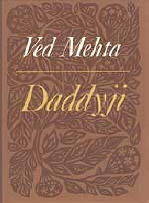
In Continents each book is organized around a central metaphor, so that while each narrative has a basis in chronological reality, its import is symbolic: “Daddyji” (1972), a cornerstone of the series and a biographical portrait of my father, is set in the nineteenth and twentieth centuries and is, by extension, the story of an ancient Hindu family from an Indian village, aspiring to enter the modern world. “Mamaji” (1979), the other cornerstone and a biographical portrait of my mother, is again set in the nineteenth and twentieth centuries; it, too, is, by extension, the story of an ancient Hindu family, but this time from an Indian city, and this time not so much aspiring to enter the modern world as trying to consolidate its place in that world. “Vedi” (1982) is the story of my stay at Dadar School from age five to eight. Originally, I had thought it would be a chapter in a larger book, but as I started writing it and thinking about the experience my memory grew and expanded to encompass more and more material by a process of association; I ended up spending two years writing about three childhood years. Although it recounts my early schooling, it also tells, by analogy, of the schooling of blind children everywhere. “The Ledge Between the Streams” (1984) is a story, at one level, of the union of two parents’ influences in their child, and, at another, of the bloody Partition, laying waste to the innocence of childhood. “Sound-Shadows of the New World” (1986) is an exploration of adolescence and of my discovery of education and liberation in America as a mid-century immigrant. “The Stolen Light,” an account of my gaining academic and sexual knowledge in California, is also a social history of the American fifties. “Up at Oxford” (1993) is about finally winning acceptance in the world and finding a place in an ancient seat of learning. “Remembering Mr. Shawn’s New Yorker” (1998), a portrait of my relationship with my mentor, is a story of that great literary institution under Shawn’s leadership. “All for Love” tells of my fumbling journey through the tunnel of love but is also a look into the workings of psychoanalysis. “Dark Harbor” (2003), a comedy of social and architectural imbroglio, is about creating a home and family late in life. “The Red Letters,” the eleventh and last book in the series, is an attempt to examine the relationship between fiction and fact and father and son. In any event, with “The Red Letters,” the design and structure of Continents is complete.
A substantial part of my writing, especially the Continents of Exile series, is based on my memory, yet I continue to be brought up short by the extraordinary tricks that memory plays, repressing and altering mundane and momentous events alike. Such tricks have relevance to any writing that relies on memory. For instance, I thought I vividly remembered a new student driving up to our school in Little Rock in a shiny Pontiac at the beginning of the school year, around 1950. “You can’t go to our school!” we cried. “You can see — you drive a car!” He said, “Yes, I can, too, go.” And he added a non sequitur: “I’m the governor’s son.” I thought I distinctly remembered the boy telling us that he had flunked out of two regular high schools and that his father, the governor of Arkansas, had rung up J. M. Woolly, our school superintendent, and said, “My son is going to your blind school. You make sure that he graduates.” As I remembered it, the governor’s son, with twenty-twenty vision, went to our school and was indulgently passed by all his teachers and got his high-school diploma. I never wrote about the boy either in “Face to Face” or in “Sound-Shadows of the New World,” the two books in which I recounted my school experiences, at first because I couldn’t easily find out which governor was the boy’s father, and I didn’t want to libel an innocent Arkansas official. Equally important, the discipline of history is in my bones; whenever I am relying on my memory for a piece of writing, I make it a point to check and recheck, and that is what I did when, one day in 1997, I was asked to write an introduction to the new edition of “Face to Face.” (As it happened, the edition never appeared, but the introduction was published in The Telegraph Magazine in India). I tracked down Woolly and asked what he remembered about the boy. He told me that the father in question was Ben Laney, who served as governor from 1945 to 1948, and that, contrary to my memory of David, as the boy was called, he was legally blind — indeed, had started at the school in 1947, two years before I got there, and graduated in 1951. I couldn’t resist protesting: “But I remember his driving up in a car!” Wooly replied, “He might have driven a car at some time. Some half-sighted people at school did mess around with cars. Boy, they probably drove you around in one of them.” So I was forced to acknowledge that David Laney was not the charlatan of my memory but in reality someone who got his high-school diploma on merit. The revelation was chastening. “How did I invent the details, right down to the Pontiac?” I kept asking myself. “Did I project my wish to drive at Pomona back onto David and the school?” Certainly, in the car culture of Southern California, I had always longed to sit in the driver’s seat and speed along a freeway with JoAn at my side. In fact, to keep up with the Pomona Joneses, I had eventually bought an old, beat-up Chevrolet and once drove it slowly by myself around the all too familiar campus with the windows open until I was threatened by the college authorities. Another time, I drove it on a freeway between Pasadena and Los Angeles with my daredevil date next to me, until in one quick lunge, she climbed over me and took control of the car to save both of us from a horrible accident.
To turn from David Laney to another, more surprising trick of memory, I thought on a conscious level that I was happy in Arkansas. I was finally going to school like my sighted brothers and sisters. I wrote to my father, my main correspondent at home, in that vein, but when talking to Woolly about Laney, a particularly revealing and frightening incident surfaced which made me realize that in reassuring my father I had been merely reassuring myself. Not only had I forgotten it but the participants whom I had assiduously interviewed in the 1980s in preparing “Sound-Shadows of the New World” had also forgotten it. In fact, the incident might never have come to light without that conversation with Woolly. A chance digression in that conversation made me realize that unconsciously I must have been extremely frightened at being an inmate of a small, crowded institution with a hundred boys and girls, and resident schoolteachers, principal, and superintendent all essentially crowded in one building, in the sticks, in an unfamiliar, vast country. I was so cut off from my family that I didn’t even have the wherewithal to go home in case of a dire emergency.
As Woolly, under my relentless prodding, told it, in May of 1951, when I was seventeen and had been at the school for nearly two years, five boys — Virgil, William, Jerry, Therrell, and Melvin were their names — struck out into the woods behind the school building on a Saturday afternoon. The five boys were near my age and I must have known them well, but after leaving the school I never gave them much thought and even forgot their names. As time went on, all my memories came to cluster around my close friends — Other, Arlie, Kenneth, George, and Max. The five boys who faded from my memory wandered deep into the woods, no doubt feeling like prisoners who had been given an afternoon off for good behavior. Weekends used to hang heavy on our hands, and the woods were the best place for boys to go if they wanted to smoke and chew tobacco, spit and argue, or, in my case, just talk or horse around away from the cramped school and the sighted school authorities. What the girls did we never knew, because although we and they were housed in two ends of the same building, they were kept separate from us, as if they were in purdah. The five boys walked about a mile over rugged and fairly rough terrain to the Arkansas River — Virgil and William, who were totally blind, no doubt being shepherded by their partially sighted friends, Jerry, Therrell, and Melvin. It must have been a hot day, and they must have worked up a sweat as they stumbled and forced their way through the woods. As soon as they reached the river, Virgil and William insisted on going for a swim to cool off. Jerry, Therrell, and Melvin apparently tried to dissuade them, but the two jumped in “as if they knew all the answers,” as Woolly put it. And yet they probably didn’t know how big or dangerous the river was. The three partially sighted boys came back to the school in the evening with the news that Virgil and William were missing. They were found the next day, dead. They had only their undershorts on and were clasped in each other’s arms. “One of them must have got caught in the undertow and grabbed the other, just as a drowning man would,” Woolly told me.
Woolly remembered going to Virgil’s funeral, in Wicks, in west Arkansas, and to William’s funeral, in Nettleton, in northeast Arkansas. He wasn’t sure whether there had been any kind of ceremony at school, but we in the boys’ dormitory must have talked in hushed voices about our dead friends. I think that because that is what we did when, at Dadar School, two boys had disappeared one night from our boys’ dormitory in mysterious, harrowing circumstances, which I have described in “Vedi.” They were presumed by us to have been killed. Afterward, if we ever talked about them it was in whispers, as if we all sensed that we would be punished for idle speculation, if not killed in their place. Indeed, in some ways, death was never far from our minds. We all felt unwanted and inadequate and imagined that we and the world both would be better off if we disappeared in the night. In any event, Virgil and William were quickly forgotten by us. I couldn’t remember who took over their beds and their lockers, or even what they had been like. Had they been defiant and truculent, like many self-confident blind people, or had they been morose and depressed, like other maladjusted students at the school? I wanted to know. Despite Woolly and I prompting each other, to these and many others questions, memory provided no answers. Woolly himself couldn’t remember the names of the drowned boys — he had to track down Melvin, another student from that time, who had spent his life operating a vending stand in North Little Rock, to find that out.
Years before my encounter with Woolly, I had gone into deep psychoanalysis. The story of how and why is told in “All for Love.” In the course of it, I had realized that for at least some of my time at school I had felt extremely sad and trapped.
Still the question remains, how is one to explain the elusiveness of these two recently disclosed incidents, forgotten or only half-remembered? The truth of them didn’t come to mind even when I was working on the Arkansas section of “Face to Face,” within a few years of leaving the school. In answer, I turn to Freud, who taught us how our minds repress unpleasant reality and what methods we should use to excavate that reality. When I am collecting, evaluating, and sifting material, I often feel like an archaeologist following hunches and clues to get at the truth. Although I sometimes feel I can do no better than quote a couple of the final sentences of “Huckleberry Finn” — “If I’d a knowed what a trouble it was to make a book I wouldn’t a tackled it. I ain’t agoing to no more” — all authors, including Mark Twain, have no choice but to go on tackling the task of making books, and, it may be, as in this case, writing addenda to them long after they are published.